
If you are planning a vegetable oil production line project—whether building a new edible oil processing plant, expanding capacity, or upgrading existing lines—the success of your investment rarely depends on the price of individual equipment. What truly matters is the system's overall performance: oil yield, energy consumption, operational stability, and long-term running costs.
QIE Group provides a one-stop solution covering raw material pre-treatment, pressing/solvent extraction, refining, installation, and commissioning. Our turnkey approach helps investors reduce project risks, shorten ROI cycles, and achieve stable, sustainable production operations. 👉(turnkey edible oil processing plant)
Building or upgrading a vegetable oil processing plant is far more complex than simply purchasing a few machines. From raw material intake, pretreatment, pressing/extractionextraction, to refining, storage, and filling, every step impacts final oil yield, product quality, energy efficiency, and overall ROI. 👉(Solvent extraction equipment)
Many plants initially attempt to assemble equipment from different vendors, thinking it reduces upfront cost, only to encounter:
Mismatched equipment interfaces leading to installation and commissioning difficulties
Actual output falling below design capacity (“bottleneck effect”)
Extended commissioning periods, delaying production
Responsibility disputes between designers and suppliers
In practice, what most affects ROI is not the cost of a single machine, but whether the entire production line runs continuously, efficiently, and cost-effectively.
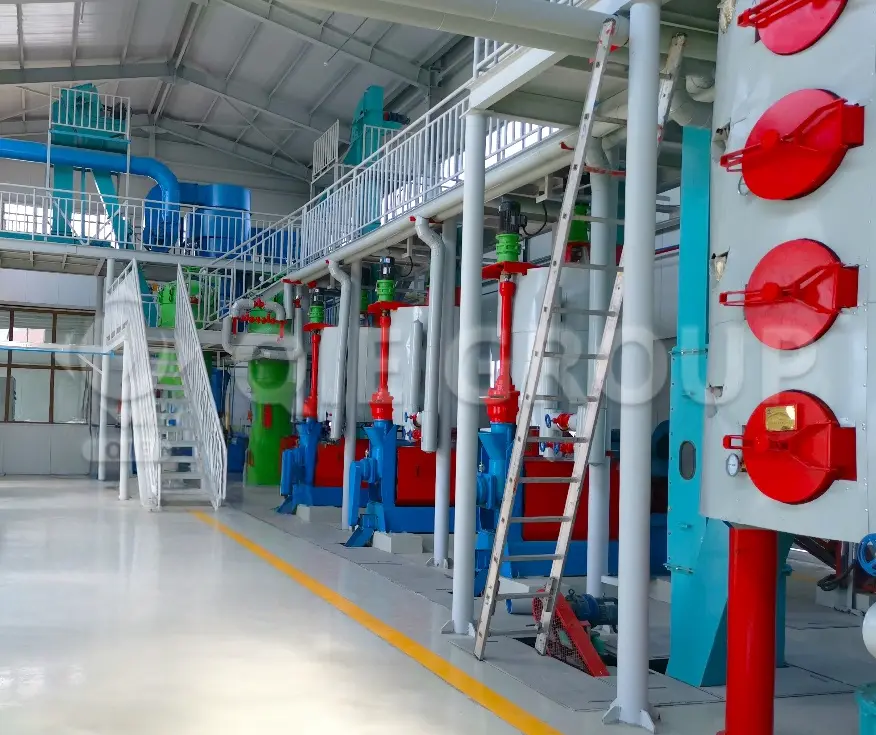
Different oilseeds have distinct processing requirements. Soybeans, rapeseed, palm fruit, rice bran, and dried coconut vary in fiber structure, moisture content, and oil distribution, meaning pre-treatment, pressing/extraction, and refining cannot simply reuse another plant's process. 👉(Rapeseed Oil Processing Hot Cold Press vs Solvent Extraction)
A client once applied a cottonseed oil process to rice bran, resulting in consistently high residual oil. The issue was not the equipment, but improper pre-treatment and cell disruption control.
QIE's Engineering Solution:
For high-fiber dried coconut, a crush-and-soften pre-treatment process
For soybeans, precise conditioning and flaking to maximize oil extraction
Oil yield is largely determined by the quality of pre-treatment.
Assembling equipment from different suppliers often reveals mismatches. For example, a peanut oil plant experienced ~30% raw material blockage because the cleaning sieve capacity didn’t match the flaking machine. This not only reduced output but also increased wear and energy consumption.
Worse, misalignment between pressing and refining stages in terms of pressure, temperature, or flow can trigger chain stoppages, disrupting production continuity.
Many investors focus on equipment costs but underestimate operational energy and labor. A poorly designed 20 T/D line may consume 10–15% more electricity than an optimized solution, while a fully automated refining system can reduce labor by approximately 60% compared with semi-automatic setups.
These “hidden costs” often appear within the first 3–6 months after commissioning, impacting cash flow and ROI.
Non-technical factors are equally critical in overseas projects. In one African project, unstable local electricity caused frequent control system alarms and stoppages.
Some projects did not allocate sufficient space for maintenance during design, causing post-installation maintenance costs to exceed 20% of initial investment. If overlooked during planning, these issues are costly to resolve later.
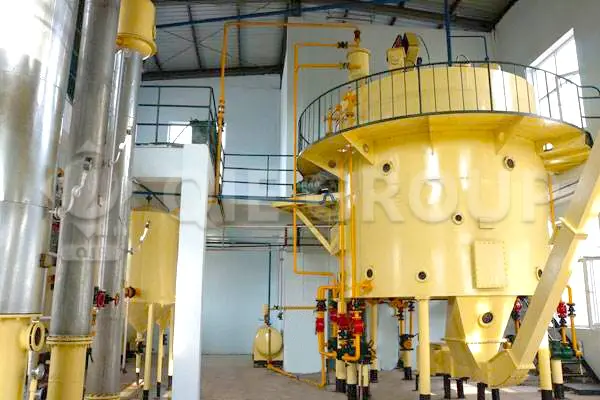
A genuine one-stop solution is not simply a bundled package of machines—it is a comprehensive system throughout the project lifecycle.
Our design starts from raw material properties—moisture, impurities, and oil distribution—rather than equipment availability. Material balance and heat balance calculations are used to optimize pre-treatment and processing paths.
Before construction, our 3D simulation system can model equipment performance under different scenarios, helping to identify potential bottlenecks and reduce trial-and-error costs.
Key equipment—cleaning, dehulling, crushing, roasting—uses standardized interfaces, allowing capacity to expand from 10 T/D to 3000 T/D. This ensures future scalability without redundant investment.
Physical Refining: Suitable for low-acid, low-impurity oils (e.g., some palm or sunflower oils), with lower energy and chemical consumption
Chemical Refining: Suitable for high-acid, high-impurity oils (e.g., rapeseed, cottonseed), offering greater process stability
The choice depends on raw oil quality and target standards, not just initial investment.
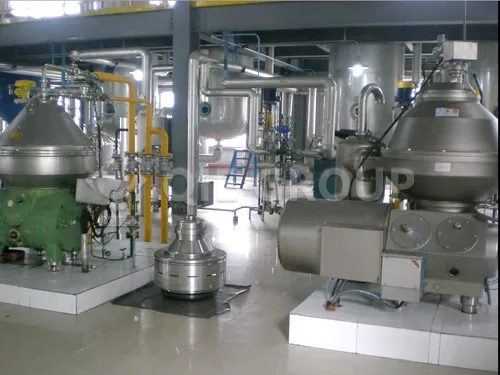
As a leading manufacturer and engineering service provider, QIE Group focuses on real operational needs, offering full-chain solutions for vegetable oil processing.
During project initiation, our engineers collaborate with clients to understand raw material variability, product grade requirements, steam/electric supply, and plant layout. Equipment selection and process design are then tailored to ensure optimal throughput and efficiency.
QIE's modern production facilities manufacture everything from pre-treatment machines, screw presses, and extraction systems to refining equipment. Standardized interfaces and matched parameters prevent installation and commissioning issues associated with third-party equipment.
Critical machines are pre-assembled and tested before shipment, reducing on-site construction time. In practice, QIE’s turnkey projects achieve about 10% faster delivery than industry average.
Installation is only the start. Our technical team participates throughout commissioning, optimizing process parameters to achieve designed capacity and product quality.
We provide long-term technical support, with overseas service networks in key markets. Rapid Response Time (RRT) for equipment faults is under 48 hours.
Standards Compliance: Project design follows AOCS, ISO, and international edible oil standards. Equipment has been successfully exported to multiple countries.
| Value Dimension | Advantage of QIE Solution | Actual Outcome |
|---|---|---|
| Stable Production | Systematic design prevents bottlenecks | Unplanned downtime reduced ~20% |
| Product Quality | Precise refining control | Consistently meets national/external standards |
| Cost Control | Optimized energy & labor | ROI shortened 3–6 months |
| Risk Reduction | Single accountability | Minimized delays and budget overruns |
A: It includes process design, equipment manufacturing, installation guidance, commissioning, training, and long-term technical support.
A: Yes. Smaller plants are more vulnerable to process mismatches, making a one-stop system even more beneficial.
A: The choice depends on crude oil acidity, impurities, and target product standards. Physical refining suits low-acid oils; chemical refining suits high-acid or high-impurity oils.
A: Yes. QIE has extensive international project experience and provides on-site or remote technical support.
A: Key metrics include oil yield, energy consumption, labor costs, equipment stability, and downtime. A one-stop solution usually shortens ROI by 3–6 months.
If you are planning a vegetable oil production line project, QIE Group offersfree preliminary process consultation and project proposals, including raw material analysis, capacity planning, and process advice.
Contact us today to receive a tailor-made, turnkey solution for your vegetable oil processing plant.
 Hot-pressed sesame oil Sesame oil yield Sesame oil production process Energy-saving and efficiency-enhancing equipment Aroma Enhancement Solution
edible oil processing equipment soybean oil processing plant palm oil production line sunflower oil refining equipment copra oil processing systems
Soybean Oil Press Manufacturers Spiral soybean oil press Soybean oil pressing production line Cold Pressed Soybean Oil Equipment Oil press failure repair
Corn Germ Oil Full pressing process Pre-pressing-leaching process Increased oil yield Edible Oil Processing
Edible oil processing plant Turnkey edible oil factory Vegetable oil production line Edible oil refining equipment Edible Oil Factory
Hot-pressed sesame oil Sesame oil yield Sesame oil production process Energy-saving and efficiency-enhancing equipment Aroma Enhancement Solution
edible oil processing equipment soybean oil processing plant palm oil production line sunflower oil refining equipment copra oil processing systems
Soybean Oil Press Manufacturers Spiral soybean oil press Soybean oil pressing production line Cold Pressed Soybean Oil Equipment Oil press failure repair
Corn Germ Oil Full pressing process Pre-pressing-leaching process Increased oil yield Edible Oil Processing
Edible oil processing plant Turnkey edible oil factory Vegetable oil production line Edible oil refining equipment Edible Oil Factory





.png?x-oss-process=image/resize,h_100,m_lfit/format,webp)
.png?x-oss-process=image/resize,h_100,m_lfit/format,webp)
.png?x-oss-process=image/resize,h_100,m_lfit/format,webp)


.webp?x-oss-process=image/resize,h_800,m_lfit/format,webp)


