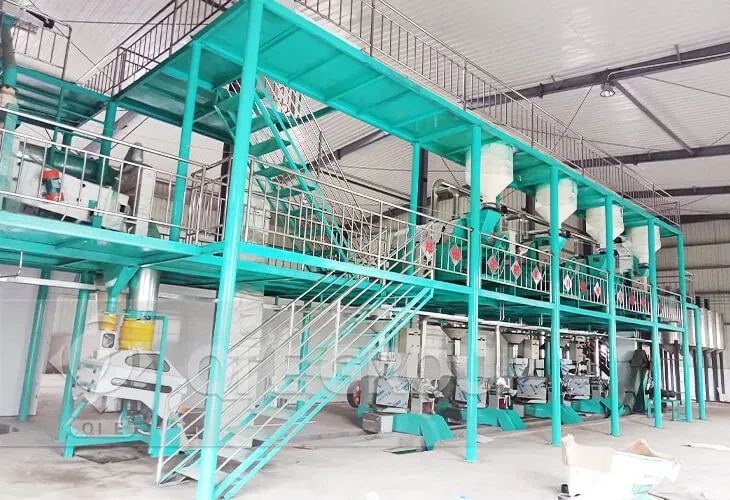
Vietnam is a dominant global rice producer, generating millions of tons of rice bran annually. However, from an industrial B2B investment perspective, extracting oil from rice bran is never as simple as buying a standard machine and "pressing it." If you choose the wrong process, your purchased equipment can easily turn into a pile of unworkable iron.
Why is this the case? How should a genuinely profitable commercial-scale rice bran oil production line (20–500 TPD) be configured? QIE GROUP breaks it down for you clearly with core factory data and straightforward insights.
Many newcomers to the industry make a critical mistake: feeding raw rice bran directly into a screw press. The typical result? The machine slips constantly, yields almost zero oil, and expels a black, mud-like powder. This is caused by two fatal physical and chemical characteristics of rice bran:
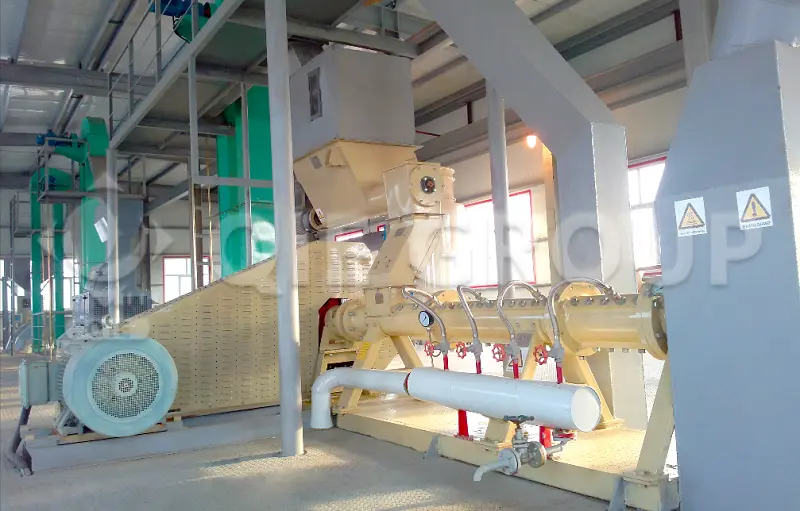
To overcome these barriers, modern medium-to-large rice bran oil mills must adopt the strategy of "using an extruder to turn powder into pellets first, then using solvent to wash the oil out."
We simplify this advanced engineering method into 4 straightforward, practical steps:
Utilizing high-efficiency vibrating screens, destoners, and strong magnetic separators, the system thoroughly removes rice hulls, broken rice, stones, and iron scraps to protect subsequent core machinery from jamming.
This is the most critical step. Rice bran enters the extruder where, under high temperature, high pressure, and direct steam injection, the lipase is completely "killed" (deactivated) within 3–5 seconds, locking the acid value. Meanwhile, loose powder is transformed into dense, highly porous, popcorn-like pellets.
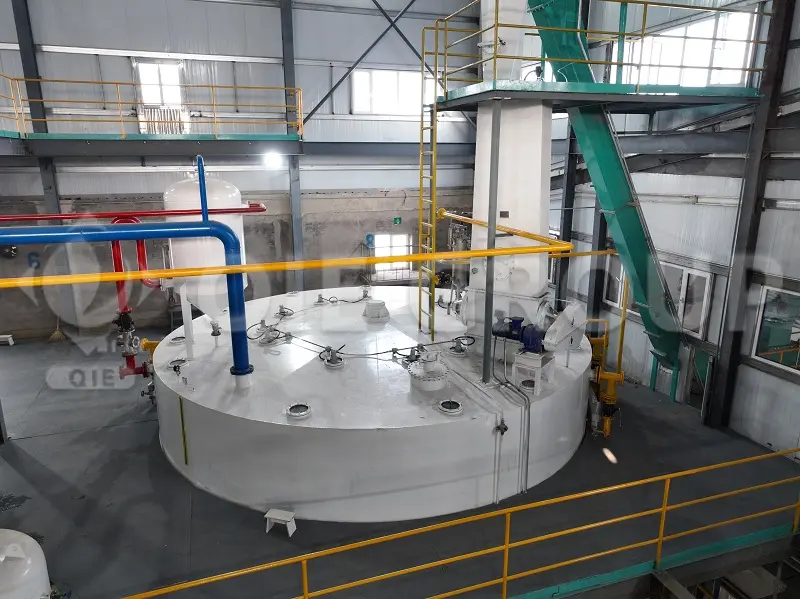
The small porous pellets formed after extrusion have excellent permeability. After entering the extractor, they are washed multiple times with solvent to fully dissolve and extract the oil. Traditional pressing methods leave 8%–10% residual oil in the cake, while our solvent extraction process can reduce residual oil to ≤0.5%!
Crude rice bran oil contains high levels of Free Fatty Acids (FFA), leading to massive oil loss in traditional chemical refining. QIE GROUP utilizes an advanced physical deacidification tower that uses steam to carry away acid compounds. It then uses low-temperature crystallization to filter out the natural wax (3%–5%) inherent in rice bran, ensuring the final oil remains crystal clear even in winter.
When evaluating a factory setup budget, do not look only at the initial equipment price. You must calculate the ongoing daily operating costs and actual oil yield once production begins:
| Evaluation Dimension | Traditional Direct Mechanical Pressing | QIE GROUP Extrusion + Solvent Extraction Line |
|---|---|---|
| Target Daily Capacity | Below 10 TPD (Small workshops) | 20 TPD — 500+ TPD (Modern commercial plants) |
| Wasted Residual Oil | As high as 8% — 10% | Below 0.8% — 1.2% |
| Acid Value Control | Hard to control; oil spoils if slightly delayed | Perfect acid lock via instant extrusion |
| Power Consumption | Over 120 kWh/ton (Severe mechanical friction) | Only 45 — 55 kWh/ton (VFD control) |
| Actual Refining Yield | Below 65% (Loss as low-value soapstock) | Up to 82%+ (Minimal oil loss) |
| Finished Oil Presentation | Cloudiness, sediment; fetches a lower price | Crystal clear; stays clear for 5.5h at 0°C |
| Total Plant Setup Budget | $50,000 — $150,000 | $250,000 — $3,000,000+ (EPC Turnkey Package) |
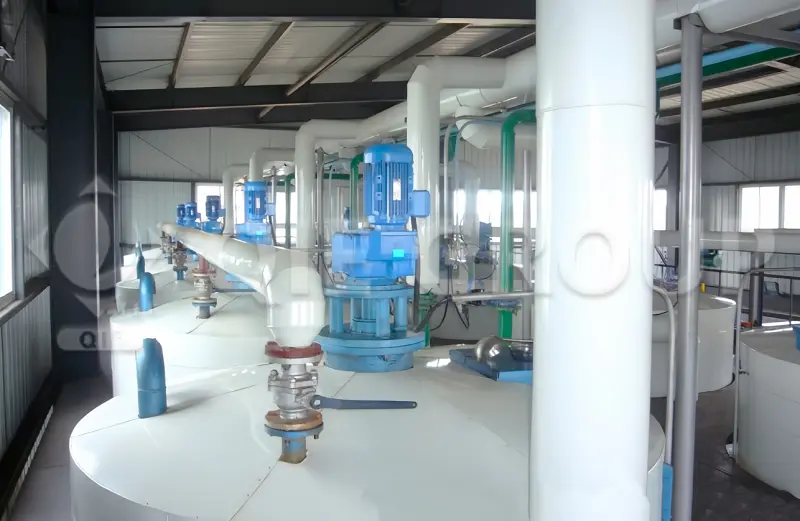
Vietnam’s rainy season brings high humidity, coastal regions pose risks of salt spray corrosion, and regional power grids can fluctuate. QIE GROUP’s full-line equipment features anti-salt spray coatings, high-humidity seals, and multi-voltage compatibility (220V/380V/400V):
• How it makes money: If you own a rice mill that produces large volumes of fresh rice bran daily, you only need this pre-treatment and extrusion setup to convert raw powder into stabilized pellets.
• The Advantage: Extruded pellets do not spoil easily and can be safely stored for 30–45 days. You can sell them at a premium to local large-scale extraction plants, earning quick returns with a lower initial investment.
• Standard Efficiency: Features a full negative-pressure solvent recovery system that keeps solvent loss below 1.2 kg per ton of raw material, saving you huge operating expenses.
• Exclusive Technology: Equipped with an Oryzanol-Protection Refining Tower. Oryzanol is the most valuable health nutrient in rice bran oil. Conventional refining equipment destroys it because temperatures exceed 260°C. QIE GROUP utilizes a low-vacuum, twin-tower physical process that maintains optimal lower temperatures, retaining over 85% of natural Oryzanol so your oil can command premium pricing as a high-end health oil.
• End-to-End Delivery: We handle everything—including factory steel structure blueprints, 3D pipeline anti-collision layout, civil engineering foundation load parameters, full Vietnamese/English HMI control interfaces, and 30 days of hands-on training for local operators.
• Peace-of-Mind Handover: All equipment undergoes a 72-hour trial run before factory dispatch, shortening your overall plant construction timeline by more than 30%.
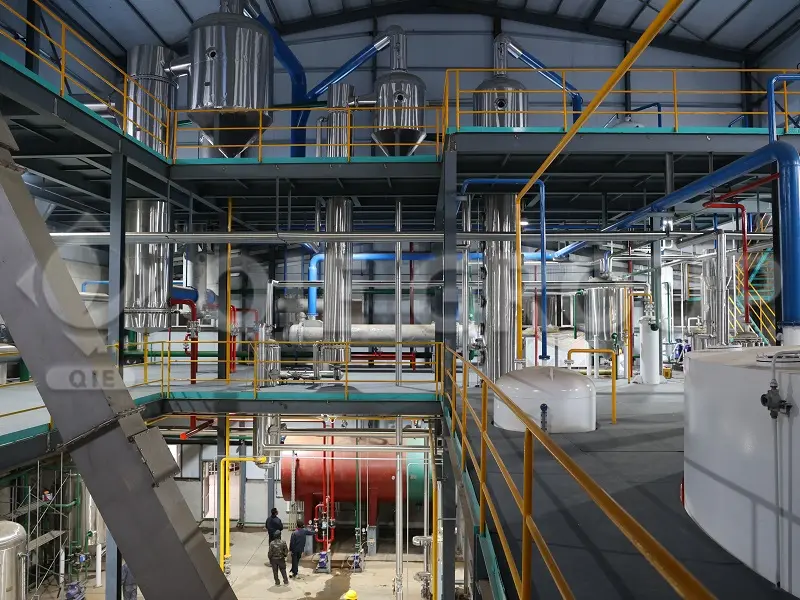
Q1: Is there a market for defatted rice bran meal left after extraction in Vietnam?
A: Yes, the market is massive. Vietnam is a livestock and aquaculture powerhouse (home to massive feed producers like CP and Japfa). Raw rice bran contains high anti-nutritional factors and spoils quickly, so feed mills limit its use. In contrast, our high-temperature extruded, defatted rice bran meal has ultra-low residual oil, excellent shelf life, and protein structures that are far easier for livestock to absorb. Feed mills readily purchase this high-grade raw material in bulk, giving you a highly stable secondary revenue stream.
Q2: Is "dewaxing" absolutely mandatory for rice bran oil? Can I skip it to save money?
A: It cannot be skipped. Rice bran contains 3%–5% natural plant wax. Without dewaxing, your oil will develop a cloudy, white cotton-like wax precipitate within hours whenever it hits temperatures below 15°C (such as northern Vietnam's winter or supermarket chillers). Such oil cannot enter modern supermarkets or pass Grade 1 VietGAP edible oil tests. Our multi-stage crystallization winterization dewaxing system compresses wax content to under 50 ppm, keeping your oil brilliant and transparent in any climate.
When preparing to build a rice bran oil plant in Vietnam, evaluate the process first, the build quality second, and the turnkey execution capability third. Saving a few thousand dollars on a cheap machine means nothing if you face daily oil leaks, clogging, and high power bills later—losses from just one or two months of bad operation can equal the cost of premium equipment.
Share your local rice bran moisture levels, your rice mill's daily output, and your target investment budget with QIE GROUP. Our edible oil engineers will provide a complimentary, tailored Complete Plant Technical Proposal & ROI Calculation Sheet.
Request Free ROI Calculation & Technical Design Palm oil production line Palm oil processing equipment Palm Oil Press Palm oil refinery QIE Group
Peanut oil production line turnkey production line Upgrading of small and medium-sized oil plants High oil yield peanut oil production line Peanut oil pressing equipment
Palm oil processing plant Palm oil startups Palm oil processing equipment Low-cost palm oil production Small palm oil mill
Sunflower oil extraction process Efficient oil production equipment Oil refining production line Pre-pressing and leaching process Vegetable oil production equipment Sunflower oil production line
palm oil processing plant smart palm oil mill palm oil pretreatment process palm oil pressing line palm oil processing equipment
Palm oil production line Palm oil processing equipment Palm Oil Press Palm oil refinery QIE Group
Peanut oil production line turnkey production line Upgrading of small and medium-sized oil plants High oil yield peanut oil production line Peanut oil pressing equipment
Palm oil processing plant Palm oil startups Palm oil processing equipment Low-cost palm oil production Small palm oil mill
Sunflower oil extraction process Efficient oil production equipment Oil refining production line Pre-pressing and leaching process Vegetable oil production equipment Sunflower oil production line
palm oil processing plant smart palm oil mill palm oil pretreatment process palm oil pressing line palm oil processing equipment




.png?x-oss-process=image/resize,h_100,m_lfit/format,webp)
.png?x-oss-process=image/resize,h_100,m_lfit/format,webp)
.png?x-oss-process=image/resize,h_100,m_lfit/format,webp)