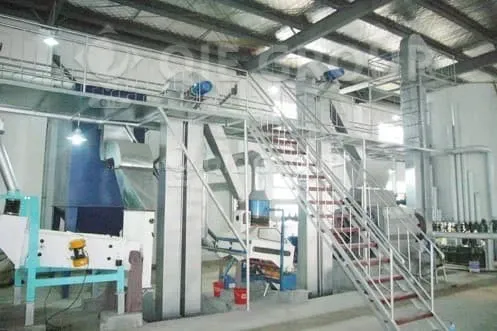
In the rice bran oil industry, process selection is not simply a matter of technological preference, but a survival-level decision. Choosing the wrong process means: high residual oil content leading to raw material waste, difficulty in refining leading to unstable quality, and mismatched investment leading to cash flow pressure.
The real pain point in the industry is:
Rice bran contains only about 15–23% oil and has very special physical properties, which makes it much more difficult to process than soybeans or rapeseed.
Industry status: Over 90% of new projects use the " rice bran extrusion + solvent extraction" process, while pressing is only used for very small-scale or high-margin products.
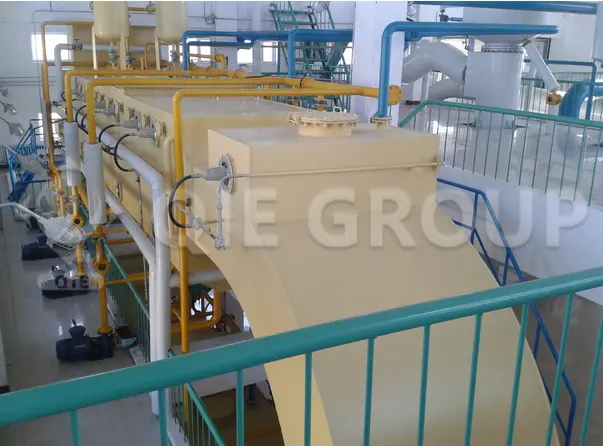
Process: Rice bran → Extrusion pretreatment → Countercurrent drying → Solvent leaching → Desolventizing (DTDC) of rice meal → Crude oil refining.
Advantages: Extremely high oil yield, residual oil rate ≤0.5%. Suitable for large-scale continuous production.
Challenges: Strict explosion-proof and fire-proof requirements, initial investment is 30%–50% higher than that of pressing.
Classification: Cold pressing (<60℃, to preserve nutrients) and hot pressing (100-120℃, to reduce the risk of rancidity).
Advantages: Simple process, no chemical solvents, and short initial investment payback period.
Challenges: Residual oil content is as high as 5%–8%. In addition, the silica in rice bran causes significant wear and tear on the screw press, resulting in high maintenance costs.
| Comparison Dimensions | Rice bran oil solvent extraction | Rice bran oil pressing |
|---|---|---|
| residual oil content | ≤ 0.5% (more thorough oil extraction) | 5% - 8% (High raw material waste) |
| Refined oil quality | First-class standard, light color, good stability | Higher acid value results in better quality after refining. |
| Applicable capacity | Prefers large-scale continuous projects with a capacity of 100 TPD or more. | More suitable for small to medium-sized (< 30TPD) projects that can be put into production quickly. |
| Security | Strict explosion-proof and environmental protection compliance are required. | Physics-related tasks, low risk |
| Investment advice | Suitable for pursuing long-term economies of scale | Suitable for rapid production or differentiated brands |
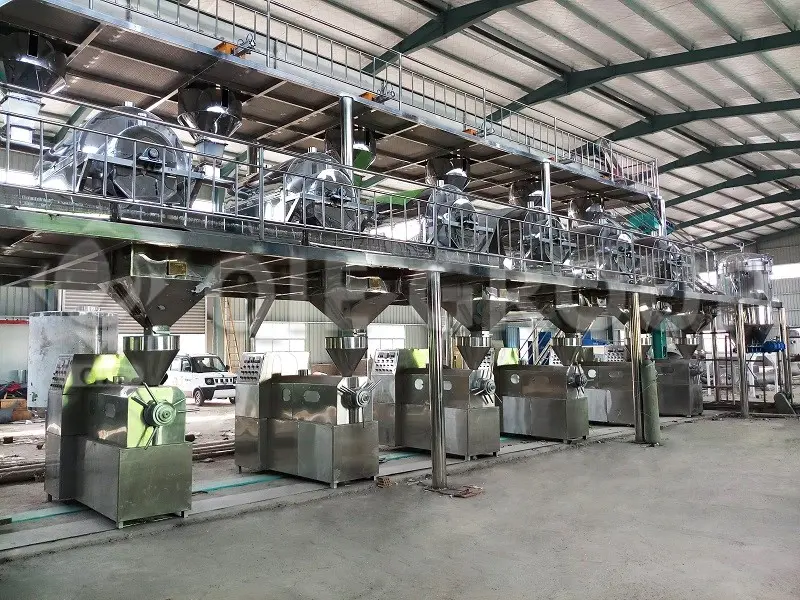
Recommended route: Focus on pressing.
Decision priority: Prioritize addressing "stabilization + preprocessing".
Business Tip: Small production capacity is more vulnerable to quality fluctuations. It's better to maintain a small scale and ensure stable refined oil product quality standards to avoid rejection by supermarkets.
Recommended route: "Combined pressing + solvent extraction" process.
Key decision-making focus: Calculating local steam and electricity prices.
Engineering suggestion: Focus on the refining section as the core, reserve interfaces for future connection to the leaching system, and balance the initial investment with the overall oil yield.
Recommended route: "extrusion + solvent extraction" main line.
Key decision-making areas: safety and environmental compliance system, unit consumption optimization, and energy cascade utilization.
Business tip: The larger the scale, the more amplified any 0.1% deviation in loss will be. It is essential to choose a supplier with EPC delivery capabilities.
1) Improve overall profitability: Turn "residual oil" into profit.
A common approach to combined processing is to obtain a certain proportion of oil through pressing at the front end, while simultaneously forming a cake more suitable for solvent extraction; and then recover the residual oil through solvent extraction at the back end. In markets with volatile raw material prices, this approach is more likely to stabilize gross profit.
2) Balancing quality and quantity: capable of both product line production and large-scale production.
The hot pressing process can deactivate lipases in rice bran, reducing the risk of rancidity and improving the quality of crude oil; the solvent extraction process can further extract residual oil, increasing the overall oil yield. This combination can increase production while ensuring product quality, meeting the needs of different markets.
3) Industry Trends: Greater emphasis is placed on controllable unit consumption and continuous operation.
The market is increasingly focused on energy consumption, losses, and compliance. The value of combined processes lies in achieving greater "controllability" under the same raw material conditions—but this requires proper system integration design and operation management.
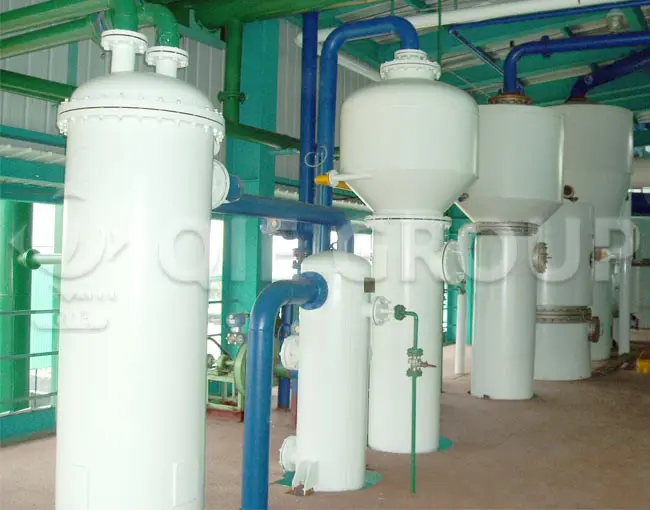
As a professional edible oil processing solutions provider, we offer more than just equipment; we offer "profit certainty":
1. Which method can achieve a higher yield?
Solvent extraction is undoubtedly the method. For rice bran, a low-oil-content raw material, reducing residual oil in the meal is key to profitability.
2. What does the investment cost (Rice Bran Oil Plant Cost) include?
It's not just the main unit. QIE's budget includes: the extrusion stabilization system, explosion-proof electrical components, solvent recovery, environmentally friendly exhaust gas treatment, and refining equipment. Breaking down the budget into modular components effectively avoids hidden cost overruns of over 20%.
3. Does the rice bran meal still have value after solvent leaching?
It is extremely valuable. Rice bran meal processed by the DTDC (Desolventizing, Drying, and Cooling) system has extremely low solvent residue and is rich in protein, making it a high-quality animal feed ingredient. For large-scale plants, the sales revenue from the meal can often cover a significant portion of their operating electricity and labor costs.
4. Why do many manufacturers emphasize that "extrusion" is the soul of rice bran oil processing?
Rice bran powder has a high degree of fineness, and direct solvent extraction or pressing can lead to "short circuits" or "clogging".
Physical effect: Expansion transforms powder into porous particles, increasing the solvent penetration area.
Biological effect: The high temperature generated during puffing instantly inactivates lipase.
Without expansion, the efficiency of the leaching system will decrease by more than 40%, and the quality of the crude oil will be extremely difficult to control.
5. Why is the "loss" during the refining process of rice bran oil higher than that of other oils? How can it be controlled?
Because rice bran oil contains high levels of free fatty acids (FFA) and waxes (approximately 3%-5%), refining loss is indeed a significant challenge.
QIE's solution: We employ a combined approach of physical and chemical refining, coupled with a precise dewaxing system. By using "negative pressure evaporation" at the solvent extraction stage to protect the quality of the crude oil, we can significantly reduce downstream refining losses and increase the overall oil yield by more than 2%.
If you require more practical decision support, the QIE Group can provide you with:
 turnkey edible oil plant edible oil processing plant cost oil refinery EPC Pressing vs solvent extraction Investment range for edible oil plant
edible oil processing oil extraction process pressing vs solvent extraction oilseed processing plant soybean oil extraction sunflower oil processing
canola oil processing plant canola oil production line edible oil factory solution rapeseed oil processing plant turnkey edible oil plant
soybean oil production line soybean oil processing pretreatment pressing extraction refining edible oil processing equipment efficient soybean oil line
soybean pre-treatment soybean oil production line soybean oil processing plant solvent extraction efficiency oilseed pre-treatment equipment
turnkey edible oil plant edible oil processing plant cost oil refinery EPC Pressing vs solvent extraction Investment range for edible oil plant
edible oil processing oil extraction process pressing vs solvent extraction oilseed processing plant soybean oil extraction sunflower oil processing
canola oil processing plant canola oil production line edible oil factory solution rapeseed oil processing plant turnkey edible oil plant
soybean oil production line soybean oil processing pretreatment pressing extraction refining edible oil processing equipment efficient soybean oil line
soybean pre-treatment soybean oil production line soybean oil processing plant solvent extraction efficiency oilseed pre-treatment equipment





.png?x-oss-process=image/resize,h_100,m_lfit/format,webp)
.png?x-oss-process=image/resize,h_100,m_lfit/format,webp)
.png?x-oss-process=image/resize,h_100,m_lfit/format,webp)