Palm oil is one of the world's most widely consumed vegetable oils, but its journey does not end with extraction and refining. Before refined palm oil can be transformed into the wide variety of cooking oils, frying oils, bakery fats, and specialty food ingredients found on the market today, it typically undergoes a critical processing step known as fractionation.
Many consumers are unaware of this process, yet it plays a decisive role in determining the appearance, functionality, and commercial value of palm oil products.
As a technical partner in edible oil processing projects, QIE GROUP regularly helps investors and processors evaluate whether fractionation should be included in their production lines. Understanding why fractionation is necessary requires looking at the unique characteristics of palm oil itself.
Refined palm oil naturally contains a mixture of triglycerides with different melting points.
When temperatures decrease, the higher-melting triglycerides begin to crystallize while the lower-melting triglycerides remain liquid. This can cause cloudiness, sediment formation, increased viscosity, or even partial solidification.
Fractionation separates these components into:
The result is a range of products with more stable physical properties and more specialized applications. Without fractionation, palm oil would have limited suitability for many modern edible oil and food manufacturing applications.
A common misconception is that once crude palm oil has been refined, it is ready for all food applications. In reality, refining only removes undesirable substances such as:
Refining does not change the natural triglyceride distribution within palm oil. As a result, refined palm oil still contains both high-melting and low-melting triglycerides in the same product. This creates challenges related to appearance, storage behavior, and application performance.
Palm oil has a unique fatty acid composition compared with many other vegetable oils. Typical fatty acid composition includes:
| Fatty Acid | Typical Content |
|---|---|
| Palmitic Acid (C16:0) | ~44% |
| Oleic Acid (C18:1) | ~39–40% |
| Linoleic Acid (C18:2) | ~10% |
| Stearic Acid (C18:0) | ~4–5% |
Because palm oil contains substantial amounts of both saturated and unsaturated fatty acids, it naturally forms triglycerides with a wide range of melting points. Some triglycerides melt below room temperature, while others remain solid until significantly higher temperatures. This difference in melting behavior forms the foundation of the fractionation process.
As storage temperatures decrease, higher-melting triglycerides begin to crystallize. This may lead to cloudy appearance, white sediment formation, reduced flowability, or partial solidification. Although this is a natural physical phenomenon rather than a quality defect, consumers often perceive cloudy oil as spoiled or inferior. For retail cooking oil products, appearance is extremely important.
Different food products require different fat characteristics. A single unfractionated palm oil product cannot efficiently satisfy all of them:
| Application | Desired Characteristics |
|---|---|
| Frying Oil | Good fluidity and thermal stability |
| Blended Oil | Clear appearance and easy handling |
| Margarine | Controlled solid fat content |
| Shortening | Plasticity and structure |
| Confectionery Fats | Specific melting profiles |
Palm oil fractionation is a physical separation process that divides refined palm oil into fractions with different melting characteristics. Unlike chemical modification processes, fractionation does not alter the chemical composition of the oil. Instead, it separates naturally occurring triglycerides according to their crystallization behavior.
The two primary products obtained are Palm Olein (the liquid fraction) and Palm Stearin (the solid fraction). Each product serves different markets and applications.
| Property | Refined Palm Oil | Palm Olein | Palm Stearin |
|---|---|---|---|
| Physical State | Semi-solid | Liquid | Solid |
| Melting Range | Broad | Lower | Higher |
| Low-Temp Appearance | May become cloudy | Clearer | Solid |
| Main Applications | General purpose | Cooking and frying oils | Margarine, shortening, specialty fats |
| Market Position | Base product | Main edible oil product | High-value specialty fat |
Several fractionation technologies exist, but dry fractionation is by far the most widely adopted in modern edible oil plants. Its advantages include: no chemical solvents required, lower operating costs, simpler process flow, easier operation and maintenance, environmentally friendly operation, and consistent product quality. For these reasons, dry fractionation is considered the preferred technology worldwide.
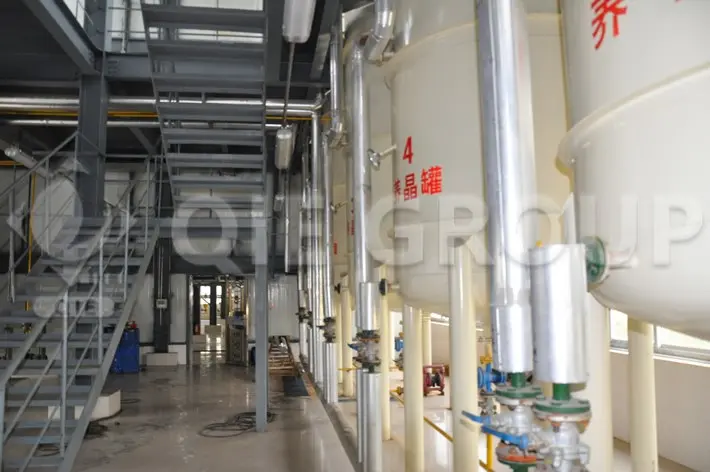
Refined palm oil is heated until all crystals are completely melted to create a homogeneous liquid phase before controlled crystallization begins.
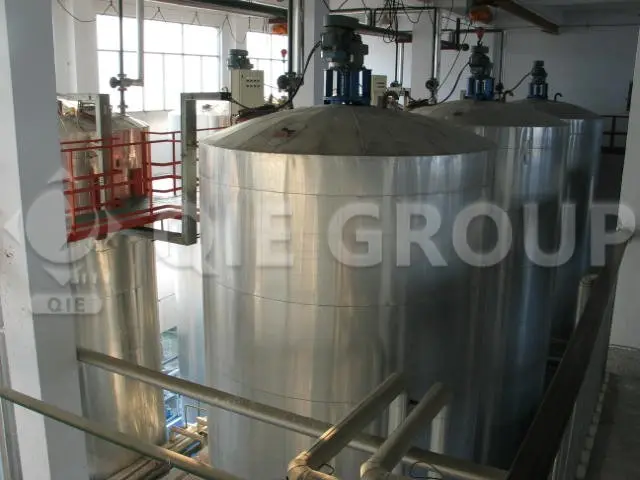
The melted oil enters crystallizers with cooling systems and agitators. Temperature reduction is carefully managed to encourage the formation of high-melting triglyceride crystals, directly influencing olein yield and stearin purity.
After crystal formation, the slurry is held to allow crystal growth and stabilization, which greatly improves filtration efficiency and product separation.
The slurry moves to automatic membrane filter presses. The liquid fraction passes through to become Palm Olein, while the solid fraction remains in the filter chamber to become Palm Stearin.
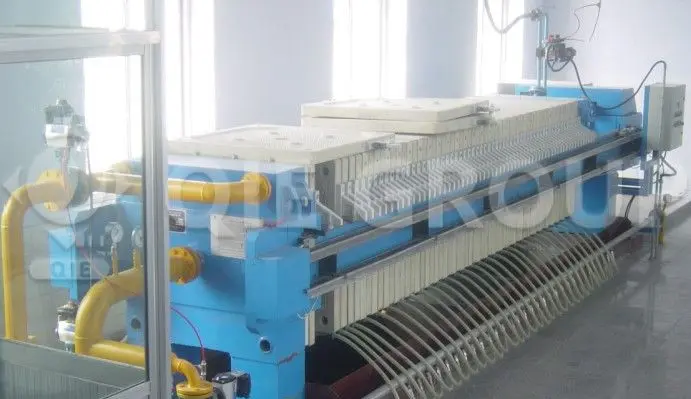
Based on QIE GROUP's practical experience in edible oil refinery and fractionation projects, the most important factor affecting fractionation efficiency is not filtration itself, but crystal formation.
If cooling occurs too rapidly, excessively fine crystals may form, filtration resistance increases, and olein recovery decreases. If cooling occurs too slowly, production efficiency decreases and energy consumption rises.
Successful fractionation therefore depends on the precise balance of: cooling rate, temperature profile, agitation intensity, crystal maturation time, and filtration conditions. This is why process engineering and automation are often more important than simply selecting larger equipment.
Fractionation is a value-creation process. Without it, processors can only sell one general-purpose refined palm oil product. With it, the same raw material can serve multiple high-value industries: retail cooking oils, commercial frying oils, foodservice operations, margarine manufacturing, bakery shortening, specialty fats, and confectionery ingredients.
Excellent fluidity, clear appearance, and good oxidative stability. Dominates most palm oil fractionation operations.
Main Applications:Cooking oils, frying oils, blended oils, foodservice operations.
Higher melting point, greater hardness, and strong structural properties. Serves higher-value niche markets.
Main Applications:Margarine, shortening, bakery fats, non-dairy creamers, soap manufacturing.
Q1: Why is palm oil fractionated?
Because refined palm oil contains triglycerides with different melting points. Fractionation separates these components into products with improved functionality and market suitability.
Q2: What is Palm Olein?
Palm Olein is the liquid fraction obtained from palm oil fractionation and is widely used in cooking oil and frying oil applications.
Q3: What is Palm Stearin?
Palm Stearin is the solid fraction obtained during fractionation and is commonly used in margarine, shortening, bakery fats, and specialty fat products.
Q4: Does fractionation change the chemical composition of palm oil?
No. Fractionation is a physical separation process and does not involve chemical reactions.
Q5: Can palm oil be used without fractionation?
Yes, but its applications may be limited due to cloudiness, crystallization, and broader melting characteristics.
Q6: What is the difference between dry fractionation and solvent fractionation?
Dry fractionation relies on controlled cooling and filtration without solvents, while solvent fractionation uses organic solvents to improve separation efficiency. Dry fractionation is the dominant industrial technology today.
A fractionation plant should be considered if:
 Peanut oil production plant Peanut oil production line Peanut oil processing equipment Peanut oil investment cost
Palm kernel oil processing PKO processing high-yield palm kernel oil screw press solvent extraction turnkey oil processing
South African peanut oil processing plant Peanut oil processing plant EPC Peanut oil refining equipment Edible oil turnkey project Investment in South African peanut oil mills
Vegetable oil processing industry Edible oil processing technology Vegetable oil refining trend Oil processing plant design Oil refinery automation Edible oil turnkey project Oil extraction and refining
Palm kernel oil production equipment Palm Kernel Oil Processing Plant palm kernel oil production line Palm kernel oil pressing and refining palm kernel oil machine
Peanut oil production plant Peanut oil production line Peanut oil processing equipment Peanut oil investment cost
Palm kernel oil processing PKO processing high-yield palm kernel oil screw press solvent extraction turnkey oil processing
South African peanut oil processing plant Peanut oil processing plant EPC Peanut oil refining equipment Edible oil turnkey project Investment in South African peanut oil mills
Vegetable oil processing industry Edible oil processing technology Vegetable oil refining trend Oil processing plant design Oil refinery automation Edible oil turnkey project Oil extraction and refining
Palm kernel oil production equipment Palm Kernel Oil Processing Plant palm kernel oil production line Palm kernel oil pressing and refining palm kernel oil machine






.png?x-oss-process=image/resize,h_100,m_lfit/format,webp)
.png?x-oss-process=image/resize,h_100,m_lfit/format,webp)
.png?x-oss-process=image/resize,h_100,m_lfit/format,webp)