
.png) Chat with Us
Chat with Us
.png) Online message
Online message
1. Processes 50 tons of peanut raw materials per day to meet basic industrial production requirements.
2. Maintains stable oil yield performance and product quality, improving production planning predictability.
3. Includes basic refining and filling capabilities to establish a complete finished oil production chain.
4. Reduces operating costs and maintenance complexity while adapting to local production conditions.
5. Improves production continuity and reduces excessive reliance on operator experience.
Based on the characteristics of peanut raw materials and the implementation conditions at the project site, the project adopts a proven, controllable, and easy-to-manage process route. It is suitable for peanuts with high oil content, ensuring process stability while controlling system complexity.
• Mature process technology, facilitating on-site commissioning and long-term operation;
• No solvent system required, providing a clearer overall investment structure;
• Suitable for localized operation and subsequent maintenance;
• Offers a certain level of scalability to support future production line upgrades.
Fluctuations in raw material moisture content and impurities:These factors may affect pressing stability and subsequent oil quality control; therefore, proper cleaning, crushing, and conditioning processes are required.
Local energy supply conditions:The boiler, thermal energy system, and production schedule need to be properly matched to ensure the operation of key processes.
Operator experience:The process design should facilitate training and implementation, reducing excessive dependence on individual operator experience.
Continuous and stable production:The pretreatment, pressing, refining, and storage and transportation systems need to remain well connected and coordinated.
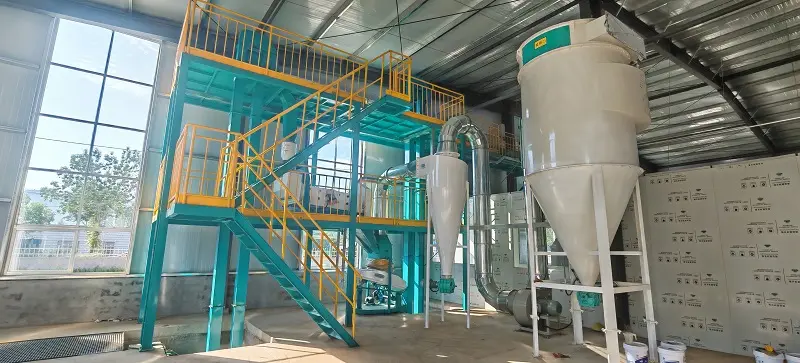
Pretreatment system optimization:A cleaning, destoning, magnetic separation, crushing, and conditioning system is configured to improve peanut raw material uniformity and reduce the impact of impurities and raw material fluctuations on the pressing process.
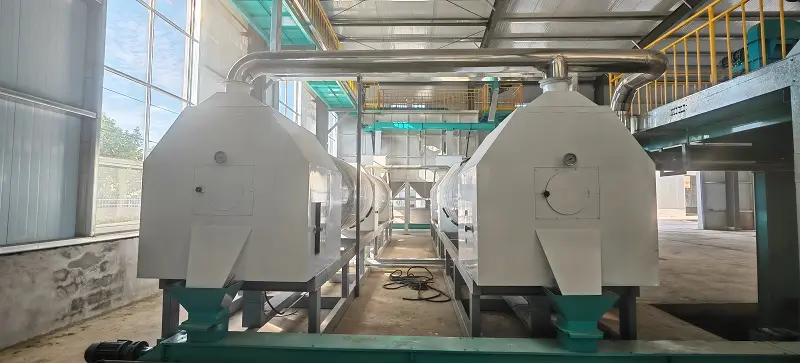
Two-stage pressing process:A pre-pressing and second pressing configuration is adopted to improve oil extraction efficiency and reduce residual oil in the cake while maintaining a controlled operating rhythm.
Refining system configuration:Basic refining processes, including degumming, deacidification, bleaching, and deodorization, are configured to improve crude oil quality and meet finished edible oil processing requirements.
Auxiliary system integration:The boiler heating system, oil storage system, automatic filling line, and laboratory testing equipment are incorporated into the overall solution to improve the completeness of plant operations.
• Peanut shelling and pretreatment system
• 50 TPD peanut oil pressing line
• 15 TPD refining system
• Boiler and thermal energy system
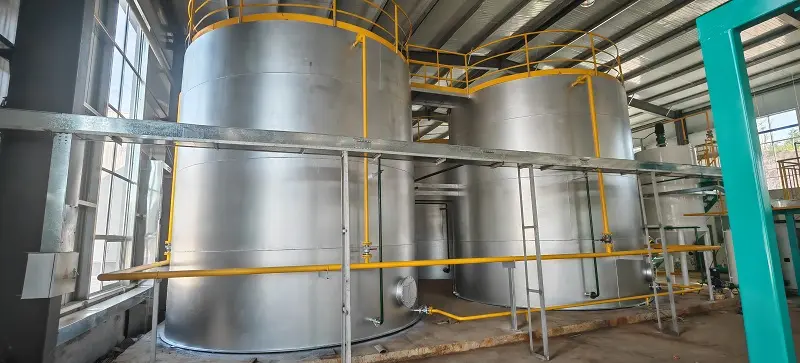
• Oil storage tank system
• Automatic filling system
• Laboratory testing equipment
• Process design and layout planning to define the production line structure and equipment coordination;
• Factory-based equipment manufacturing to ensure key units meet project requirements;
• On-site installation and system integration to complete the connection and matching of all process sections;
• Integrated commissioning and operational optimization to improve overall production line consistency.
Through integrated production line delivery, the customer does not need to coordinate multiple system suppliers separately, enabling more centralized project execution and clearer subsequent operation management.
• Capable of processing 50 TPD of raw peanuts;
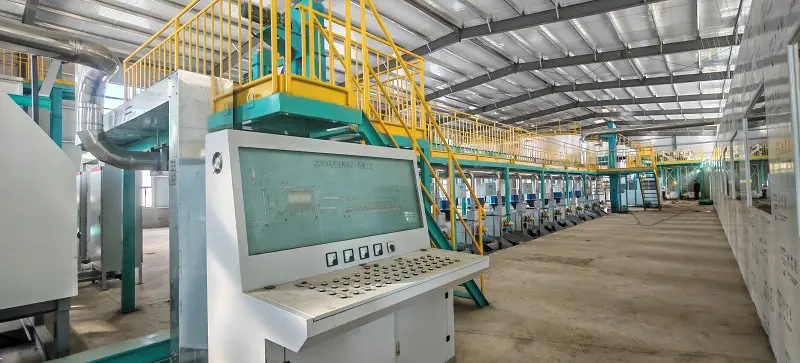
• The production line supports continuous operation, ensuring a more stable process flow;
• Peanut pressing, refining, oil storage, and filling form a complete production chain;
• Equipment maintenance and production management are more clearly structured, facilitating operation by the local team;
• Allows room for future capacity optimization and process upgrades.
Residual Oil in Cake:≤5–6%
Crude Oil Impurities:≤0.2%
Moisture Content:≤0.2%


.png?x-oss-process=image/resize,h_100,m_lfit/format,webp)
.png?x-oss-process=image/resize,h_100,m_lfit/format,webp)
.png?x-oss-process=image/resize,h_100,m_lfit/format,webp)